


Bench Staffing vs. On-Demand Hiring in Software Development Outsourcing
Which model offers better cost, speed, and scalability for outsourced development teams?
What Is Bench Staffing in Software Outsourcing?
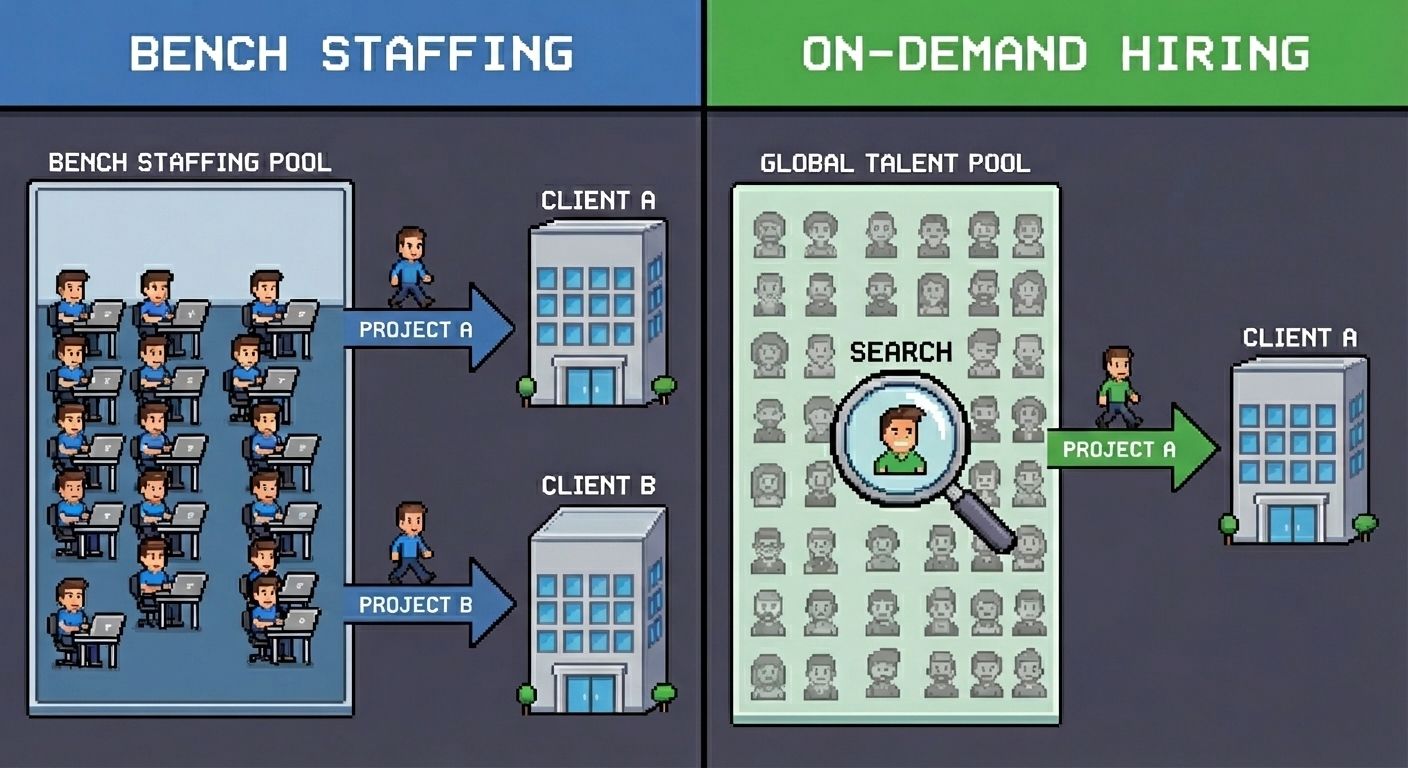
In software outsourcing, bench staffing refers to keeping a pool of professionals on a company’s payroll who are not currently assigned to a client project. This approach is common among large global outsourcing providers such as IBM, Accenture, Capgemini, and Deloitte.
By keeping a talent bench ready, these companies can promise clients faster ramp-up times and immediate access to dedicated development teams when new projects arise. While bench staffing offers speed and convenience, it carries tangible costs that companies relying on software development outsourcing should evaluate when choosing a service provider.
Advantages of Bench Staffing
1. Faster ramp-up time
With bench employees already in place, projects can start almost immediately. Companies with a talent bench can reassign unallocated staff or shuffle team members across projects to meet new demand quickly.
2. Flexibility in scaling
Bench staffing makes it easier to handle sudden absences or scale up a team mid-project. A service provider with bench resources can often supply additional outsourcing development teams faster than those who rely solely on recruiting.
3. Pre-vetted professionals
Bench employees are typically tried and tested. Whether they are full-time developers or pre-screened contractors, they have already gone through internal vetting and are ready to integrate into projects with minimal onboarding.
Bench Staffing Disadvantages
1. Cost burden
Maintaining a bench is expensive. Service providers must cover salaries, benefits, and overhead for non-billable staff – and these costs are ultimately passed on to all their clients (even those requesting on-demand hiring), raising the overall project price.
2. Risk of attrition
Skilled engineers don’t like to sit idle. Long stretches on the bench can lead to boredom, reduced motivation, and even loss of technical sharpness, increasing the risk that top performers leave.
3. Skillset and culture mismatch
With bench staffing, the professional assigned to your project might not be the best fit. The provider may choose someone from their bench who is available, even if their skills or personality do not fully match your project needs or company culture.
What Is On-Demand Hiring?
The direct alternative to bench staffing is on-demand hiring. In this model, outsourcing providers bring in developers only when a new project begins. Instead of keeping bench employees idle, they tap into pre-qualified talent pools or recruit actively to assemble the right dedicated development team for each client.
This approach is especially common among smaller or specialized firms that aim to stay lean, minimize overhead costs passed on to projects, and deliver a more tailored, client-focused experience.
On-Demand Hiring Advantages
1. Cost efficiency
Since there are no idle salaries to absorb, outsourcing software development through on-demand hiring typically costs less. Clients don’t pay for overhead tied to non-billable bench resources.
2. Better project and personality fit
Providers hire specifically for your tech stack, industry, and requirements. This ensures the developers are a strong match – not only in skills but also in personality and working style. In most cases, you can review or interview candidates during recruitment to confirm both technical and cultural alignment.
3. Market adaptability
On-demand staffing solutions let companies pivot quickly into new technologies or domains without worrying about reskilling existing bench employees. Each hire is tailored to the project at hand.
Limitations of On-Demand Hiring
1. Slower start times
Without a talent bench, providers may need extra time to source and onboard developers. If your project is urgent, this delay could be a disadvantage.
2. Scaling limitations
While a bench-heavy provider can assign dozens of engineers in a week, a company that hires on demand may struggle to ramp up large outsourcing development teams at short notice.
If you’re considering software outsourcing, understanding the difference between bench staffing and on-demand hiring will help you choose the right partner – and build a dedicated development team that aligns with your project goals.